
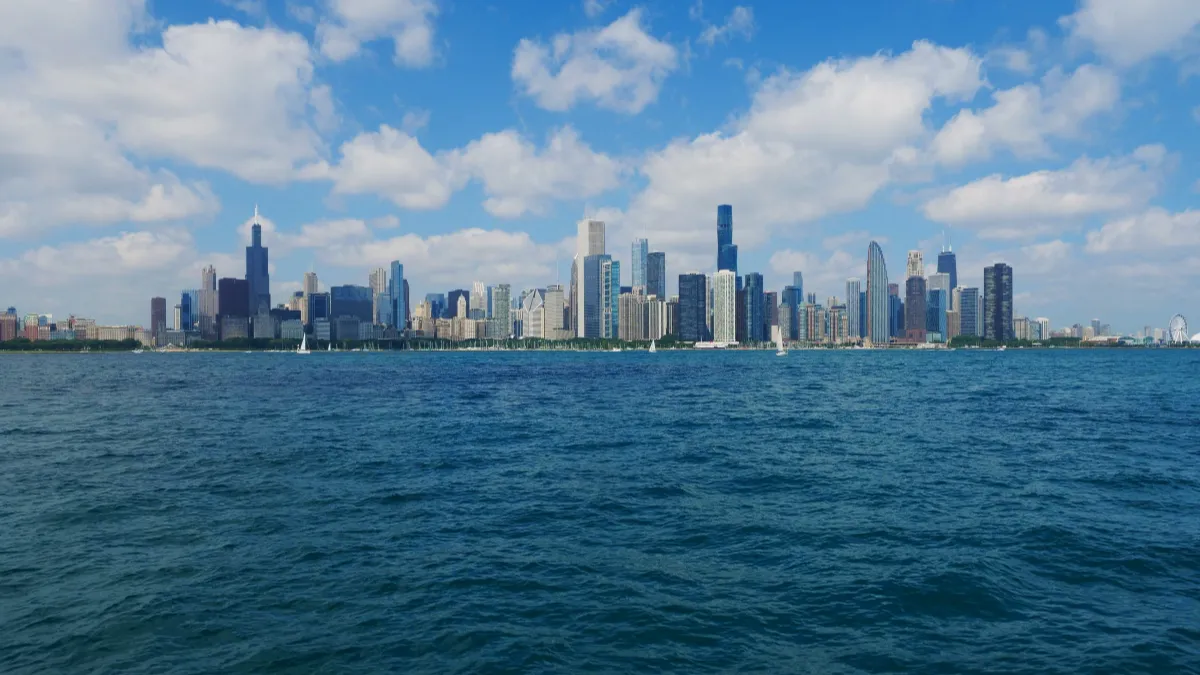
Chicago water hardness averaged 139 mg/L (about 8.1 grains per gallon) in the treated water the city tested from January 2025 to April 2026, according to the Department of Water Management’s quarterly chemical analyses. That’s hard on the USGS scale, but only just. Every one of the 42 treated samples fell between 126 and 146 mg/L, so if you run a softener, set it to 9 gpg.
On this page
- What is Chicago's water hardness?
- Chicago water hardness by plant and quarter, 2025–2026
- Why Chicago's hardness barely changes: Lake Michigan and two plants
- Why other websites give different numbers for Chicago
- Do you need a water softener in Chicago?
- What size water softener does a Chicago home need?
- How much salt does a softener use on Chicago water?
- Does the same hardness apply to Chicago suburbs?
- Chicago water hardness FAQ
8.1 gpg 139 mg/L · treated water, 2025 to April 2026
City of Chicago Department of Water Management, Comprehensive Chemical Analysis, Q1 2025 to Q2 2026 (average of 42 treated-water results). Scale: USGS classes up to 300 mg/L.
What is Chicago’s water hardness?
Chicago’s tap water is hard, at roughly 8 gpg. The city publishes a full chemical analysis four times a year, and across six quarters (2025 and the first half of 2026) the treated water leaving both purification plants, and the samples taken out in the pipe network, never dropped below 126 mg/L or rose above 146 mg/L as calcium carbonate.
The USGS puts water between 121 and 180 mg/L in its “hard” band, so Chicago sits near the soft end of hard. In the units appliance manuals use, the lowest treated sample is 126 mg/L (7.4 gpg, 7.1 °dH), the average 139 mg/L (8.1 gpg, 7.8 °dH, 1.39 mmol/L) and the highest 146 mg/L (8.5 gpg, 8.2 °dH, 1.46 mmol/L). Our water hardness converter does the same sums for any number.
Chicago water hardness by plant and quarter, 2025–2026
Chicago treats Lake Michigan water at two plants: Jardine, near Navy Pier, and Sawyer (formerly South) on the South Side. Each quarterly report lists the raw lake water, the water leaving each plant’s outlets and samples from the distribution system served by each plant. The table keeps only the treated results, the water that actually reaches taps.
| Quarter (sampling dates) | Sawyer: range | Sawyer: average | Jardine: range | Jardine: average |
|---|---|---|---|---|
| Q1 2025 (Jan 6–8) | 142–143 | 142 | 141–143 | 142 |
| Q2 2025 (Apr 7–9) | 143 | 143 | 142–143 | 143 |
| Q3 2025 (Jul 7–9) | 134–142 | 137 | 134–141 | 138 |
| Q4 2025 (Oct 6–8) | 128–135 | 131 | 126–140 | 133 |
| Q1 2026 (Jan 5–6) | 137–146 | 141 | 136–146 | 141 |
| Q2 2026 (Apr 6–7) | 137–142 | 140 | 138–141 | 140 |
Two things stand out. The plants are almost identical: over all six quarters Sawyer’s treated water averaged 139.0 mg/L and Jardine’s 139.4. And the seasonal swing is small. The lowest readings came in October 2025, about 10 mg/L below the spring, which is less than one grain per gallon.
Why Chicago’s hardness barely changes: Lake Michigan and two plants
Every drop comes from one source. Chicago draws its water from Lake Michigan through offshore intakes, and a lake that size mixes slowly and evenly, so its mineral content doesn’t jump around the way river water or a mix of wells can. Calcium in the 2025 tests stayed between about 33 and 38 mg/L and magnesium between about 11 and 13 mg/L.
Treatment doesn’t remove that hardness. Compare the raw and treated columns in the city’s reports and they track each other: in the second quarter of 2025, raw lake water at Sawyer measured 143 mg/L and its outlets 143 too. Purification plants like these clean and disinfect water; they don’t soften it.
For you, that consistency is good news. A softener set once stays right all year, and you don’t need to chase a seasonal number the way people do in cities that switch between river and well water.
Why other websites give different numbers for Chicago
Search for Chicago water hardness and you’ll find figures from about 7.5 gpg to more than 19 gpg, sometimes on pages from the same company. The official data doesn’t support that spread. A few reasons it happens:
- Old or unnamed sources. A figure with no utility, year or link can’t be checked, and some are simply copied from page to page.
- Groundwater estimates. Some sites use USGS or county estimates of local groundwater, which in the Chicago area can be far harder than the lake. Chicago taps don’t get that water.
- ZIP-code tables. A ZIP code can cover homes on different systems, and a few databases fill gaps with averages.
The rule we follow on every city page: use the utility’s own test results, say which year, and link to the report. If your figure came from a test strip, check it against the table above before you program anything; our guide on how to test water hardness explains why strips often read a grain or two off.
Do you need a water softener in Chicago?
You don’t need one, but at 8 gpg you’ll notice the hardness. Expect white spots on glasses and shower glass, scale in kettles and coffee makers, and more soap or detergent to get the same lather. Water heaters collect scale faster in hard water, and some tankless water heater warranties set limits or maintenance rules by hardness.
Whether a softener is worth it comes down to how much those things bother you, and how much salt and water you’re willing to spend. Chicago’s water is at the soft end of “hard”, so the case is weaker here than in cities at 15 gpg or more. Our guide do I need a water softener? walks through the trade-offs, and a cheaper middle path is to descale the kettle and coffee maker on a schedule.
The city tests its water for safety separately from hardness. If you have questions about lead or other contaminants, those are for the Department of Water Management and its annual water quality report, not a softener.
What size water softener does a Chicago home need?
For most Chicago households, a 24,000 or 32,000 grain softener is plenty. Use 8.5 gpg, the highest treated reading, so the numbers cover the hardest water the city delivered. At an average of 80 gallons per person per day (the USGS estimate we use for sizing), each person removes 680 grains a day. A family of four removes 2,720, which gives about 9 days between regenerations on a 24,000-grain softener, 12 on a 32,000 and 18 on a 48,000; two people get 18, 24 and 35 days, and six people 6, 8 and 12 (before any reserve).
Very long cycles aren’t a goal in themselves. Metered softeners usually have a “day override” that forces a regeneration after a set number of days even when capacity remains, so an oversized unit doesn’t save much. The full method is in what size water softener do I need.
Quick example: a family of four in Lincoln Park
Four people use about 320 gallons a day. At 8.5 gpg that’s 2,720 grains a day, or about 19,000 a week. A 32,000 grain softener covers roughly 12 days between regenerations; a 24,000 grain unit covers about 9. Either works. The calculator below is already set to Chicago’s 8.5 gpg and four people.
This calculator needs JavaScript. The table above covers 1 to 6 people.
How much salt does a softener use on Chicago water?
A four-person Chicago home needs roughly 290 to 300 pounds of softener salt a year, about seven or eight 40-pound bags. That assumes a softener that meets the NSF/ANSI 44 efficiency rating of 3,350 grains removed per pound of salt, and a 40 lb bag at $8.76 (Morton, Walmart, October 2026), about $63 to $65 a year. One person needs roughly 71 to 74 lb, two about 145, five about 360 to 370 and six about 430 to 445 lb. Older timer-based softeners can use far more.
Put your own household, bag size and price into the softener salt calculator, and see how much salt a water softener uses for why older units waste salt.
Does the same hardness apply to Chicago suburbs?
Often, but check your bill. Chicago sells treated water to many suburbs, and a lot of their annual reports say plainly that their supply is Lake Michigan water bought from the city. Schaumburg’s 2025 report, for example, says all of its water comes from Lake Michigan through Chicago’s Jardine plant. If your town is one of them, the figures above apply to you.
Not every suburb works that way. Some get lake water through regional commissions, some blend in well water, and some rely on wells completely, which can be much harder. Your own utility’s annual report is the place to check; our guide to reading a water quality report shows where hardness usually appears, and the water hardness by city page compares Chicago with the other cities we’ve verified.
Chicago water hardness FAQ
Is Chicago water hard or soft?
Hard. The 42 treated samples from 2025 to April 2026 averaged 139 mg/L, inside the USGS “hard” band of 121 to 180 mg/L, though close to its lower end.
What hardness should I set my softener to in Chicago?
9 gpg. It’s the highest treated reading (8.5 gpg) rounded up. If your softener asks for ppm or mg/L, use 150. Our guide to the water softener hardness setting explains why rounding up is safer.
What dishwasher setting should I use in Chicago?
Use 8 °dH (1.4 mmol/L) and find the matching level in your dishwasher’s manual. Our dishwasher hardness setting guide shows how makers such as Bosch map hardness to their settings.
Does Chicago water hardness change with the seasons?
A little. In the city’s 2025 tests, autumn readings ran about 10 mg/L lower than spring ones, under one grain per gallon. That’s too small to need a seasonal softener setting.
Sources
- City of Chicago Department of Water Management: Comprehensive Chemical Analysis (quarterly reports, 2025 and 2026 Q1–Q2)
- Village of Schaumburg: 2025 Annual Water Quality Report (PDF): Lake Michigan source, Jardine and South plants
- USGS Water Science School: Hardness of Water
- PNNL Building America Solution Center: Water Softeners (NSF/ANSI 44 efficiency rating)