
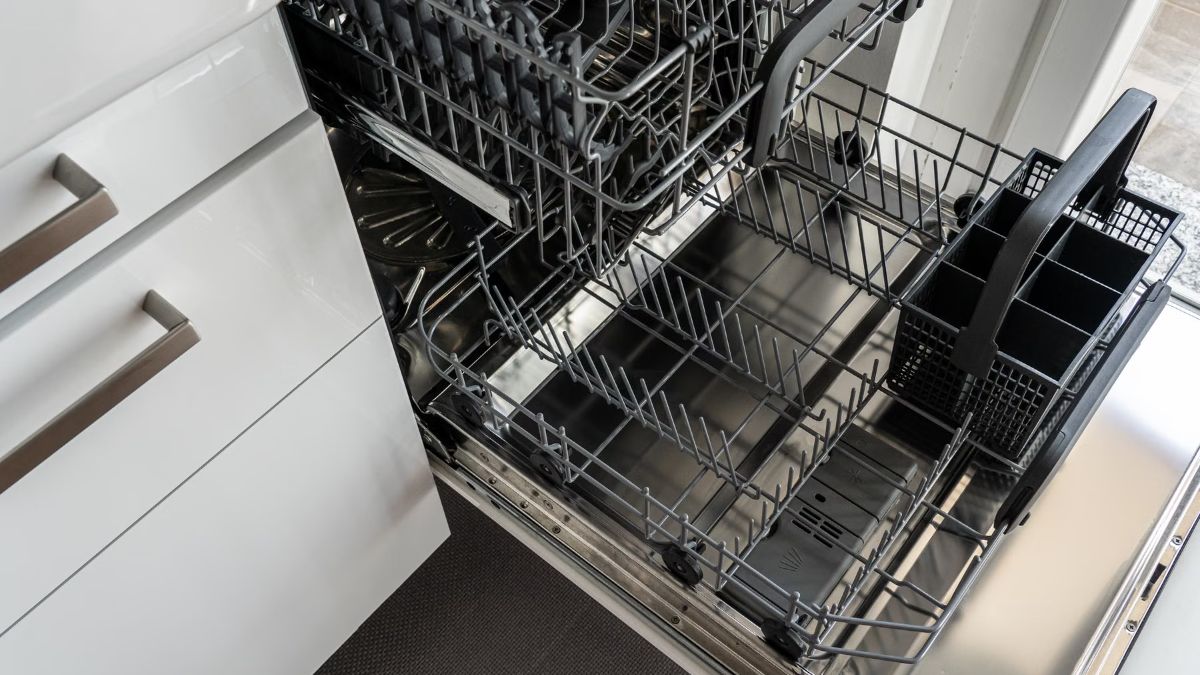
Set your dishwasher’s water hardness to match your tap water, converted into the unit your manual uses. On a Bosch dishwasher, for example, water of 1.9 to 2.1 mmol/L (190 to 210 mg/L, or 11.1 to 12.3 gpg) goes on level H03. If a softener already treats your whole house, use the lowest level. Too low a setting leaves spots and scale; too high a setting wastes dishwasher salt.
On this page
- Step 1: find your water hardness
- Step 2: convert to your dishwasher’s unit
- Step 3: match it to a level (Bosch table)
- Examples from real water reports
- How to change the setting
- Dishwasher salt: the other half of the job
- If you have a whole-house water softener
- Signs the setting is wrong
- Frequently asked questions
Dishwashers with a built-in water softener regenerate a small resin bed with dishwasher salt. The hardness setting tells the machine how often to do it. Below is how to find your number, convert it, and match it to a level, with the full table for Bosch models.
Step 1: find your water hardness
Your water utility publishes it every year in its water quality report; our guide to the water hardness scale explains the units. UK water companies usually have a postcode checker. On a private well you need a test.
Whatever the figure, write down the unit too. Dishwasher manuals use mmol/L, German degrees (°dH), French degrees (°f), Clark degrees (°e) or, on some US models, grains per gallon. Mixing them up is the most common mistake.
Step 2: convert to your dishwasher’s unit
All the units measure the same thing, the calcium and magnesium in the water expressed as calcium carbonate. The factors are fixed:
| To get | Divide mg/L by | Example: 280 mg/L |
|---|---|---|
| mmol/L | 100.09 | 2.8 |
| German degrees (°dH) | 17.848 | 15.7 |
| French degrees (°f) | 10 | 28.0 |
| Clark degrees (°e) | 14.254 | 19.6 |
| Grains per gallon (gpg) | 17.118 | 16.4 |
Step 3: match it to a level (Bosch table)
Bosch’s instructions list eight settings, from H00 to H07, by mmol/L. We’ve added the same ranges in the other units so you can read off your level directly.
| Setting | mmol/L (Bosch) | mg/L or ppm | gpg | °dH | °e (Clark) |
|---|---|---|---|---|---|
| H00 | 0–1.1 | 0–110 | 0–6.4 | 0–6.2 | 0–7.7 |
| H01 | 1.2–1.4 | 120–140 | 7.0–8.2 | 6.7–7.9 | 8.4–9.8 |
| H02 | 1.5–1.8 | 150–180 | 8.8–10.5 | 8.4–10.1 | 10.5–12.6 |
| H03 | 1.9–2.1 | 190–210 | 11.1–12.3 | 10.7–11.8 | 13.3–14.7 |
| H04 | 2.2–2.9 | 220–290 | 12.9–17.0 | 12.3–16.3 | 15.4–20.4 |
| H05 | 3.0–3.7 | 300–370 | 17.5–21.6 | 16.8–20.7 | 21.1–26.0 |
| H06 | 3.8–5.4 | 380–540 | 22.2–31.6 | 21.3–30.3 | 26.7–37.9 |
| H07 | 5.5–8.9 | 550–890 | 32.2–52.0 | 30.8–49.9 | 38.6–62.5 |
If your figure falls between two rows (for example 1.15 mmol/L), choose the higher level. Other brands use their own scales and numbers of levels, so use this table only for Bosch and check your manual for anything else.
Examples from real water reports
| Water | Published figure | mmol/L | Bosch level |
|---|---|---|---|
| Austin, TX (average) | 93 mg/L | 0.93 | H00 |
| Austin, TX (highest sample) | 126 mg/L | 1.26 | H01 |
| Typical “hard” water | 10 gpg | 1.71 | H02 |
| Las Vegas, NV | 280 mg/L (16 gpg) | 2.80 | H04 |
| San Antonio, TX | 15–20 gpg | 2.57–3.42 | H04–H05 |
Where a utility gives a range, set the level for the upper end. A slightly high setting costs a little extra salt; a low one leaves film on glasses on the days the water is at its hardest.
How to change the setting
On many current Bosch models, the UK help page describes the same three steps: hold the Setup button (or SpeedPerfect/VarioSpeed on models without it) for 3 seconds, press Start repeatedly until the right H level shows, then hold the same button for 3 seconds to save. Buttons differ by model, so if yours doesn’t respond, look up the manual by model number.
Other makes hide the setting in a settings menu or under a combination of buttons. Search the manual for “water hardness” or “water softening system”.
Dishwasher salt: the other half of the job
The setting only works if the salt compartment has salt in it. Wessex Water reminds customers to keep both the salt and rinse aid containers topped up. Bosch’s instructions add a few rules worth following:
- On first use, fill the salt compartment with water before adding salt.
- Add salt just before running a programme, so any spilled salt is rinsed away.
- Never put detergent in the salt compartment.
Use salt sold for dishwashers, as the manual specifies.
If you have a whole-house water softener
Softened water should already be close to zero hardness, so set the dishwasher to its lowest level (H00 on Bosch). Check the softened water with a test strip first: if it isn’t close to zero, the house softener needs attention, not the dishwasher. Our guide to water softener maintenance covers the usual causes.
Signs the setting is wrong
Too low: white film or spots on glasses, a gritty feel on plates, scale building up on the heating element and inside the door.
Too high: the salt runs out far sooner than expected.
White marks can also come from too little rinse aid or the wrong detergent dose. Fix the hardness setting first, then adjust those. For scale that has already built up, see how to remove limescale.
Frequently asked questions
What should I set my dishwasher water hardness to?
The level that matches your tap water’s hardness in your manual’s unit. For Bosch, convert your figure to mmol/L and read the H level from the table above.
Do I need dishwasher salt if I have soft water?
If your water falls in the lowest band (under 1.1 mmol/L for Bosch) and the machine is set to it, the softener barely regenerates, so you’ll need little or none. Your manual says whether the salt light switches off at that level.
What does H04 mean on a Bosch dishwasher?
It’s the setting for water of 2.2 to 2.9 mmol/L, which is 220 to 290 mg/L or 12.9 to 17.0 gpg.
Can I use table salt instead of dishwasher salt?
Bosch’s instructions call for special dishwasher salt, so use that rather than table salt. Check your own manual for the product it names.
Is ppm the same as mg/L for this?
Yes. For water, 1 ppm equals 1 mg/L, so 250 ppm is 2.5 mmol/L.