
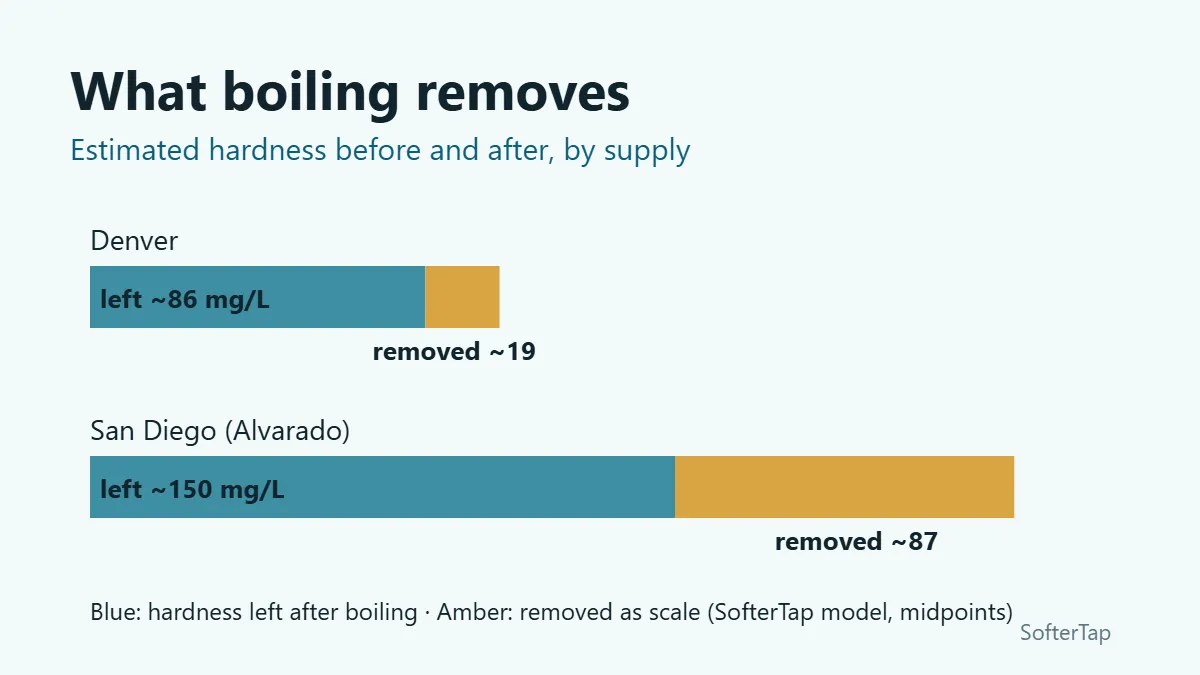
Does boiling water soften water? Only a little: it removes the carbonate part of hardness, and only some of that. In five real water supplies we ran the numbers for, boiling took out an estimated 14% to 41% of the hardness, so Denver-type water stayed moderately hard and San Diego-type water stayed hard. The rest, called permanent hardness, does not boil out, and boiling water away makes it more concentrated.
On this page
- Does boiling water soften water? The chemistry in short
- Temporary and permanent hardness in real tap water
- How much hardness does boiling actually remove?
- Where the hardness goes: scale in your kettle
- Boiling longer can make the permanent part worse
- What actually softens water
- Boiling hard water FAQ
Does boiling water soften water? The chemistry in short
Hardness is dissolved calcium and magnesium. A lot of it travels as bicarbonate, and heat breaks bicarbonate down. The calcium then drops out as solid calcium carbonate, the white scale you find in a kettle. The USGS notes that heating hard water forms solid deposits of calcium carbonate, which is why water heaters scale up.
The FAO’s water chemistry reference splits hardness in two. Carbonate hardness is “temporary” because the carbonates come out as scale on boiling. Non-carbonate hardness is “permanent” because it cannot be removed by boiling. Real tap water has both, so boiling can only ever do part of the job.
The scale that forms is the hardness leaving the water. That is why a kettle in a hard-water area fills with crust while the water in it is still hard. Our hard vs soft water guide covers how the two differ in daily use.
Temporary and permanent hardness in real tap water
A water quality report lets you estimate the split. Carbonate hardness is the lower of two numbers: total hardness and alkalinity (both as calcium carbonate). Whatever hardness is left over is non-carbonate, and no amount of boiling will touch it.
| Water supply | Total hardness | Alkalinity | Carbonate share | Non-carbonate (stays) |
|---|---|---|---|---|
| Denver Water, 2025 average | 105 mg/L (6.1 gpg) | 65 mg/L | 62% | 40 mg/L (2.3 gpg) |
| Grand Haven, MI, July 2025 | 139 mg/L (8.1 gpg) | 113 mg/L | 81% | 26 mg/L (1.5 gpg) |
| San Diego, Alvarado plant, 2025 | 237 mg/L (13.8 gpg) | 118 mg/L | 50% | 119 mg/L (6.9 gpg) |
| San Diego, Miramar plant, 2025 | 242 mg/L (14.1 gpg) | 110 mg/L | 45% | 132 mg/L (7.7 gpg) |
| San Diego, Otay plant, 2025 | 243 mg/L (14.2 gpg) | 123 mg/L | 51% | 120 mg/L (7.0 gpg) |
The pattern matters more than any one row. A supply that is mostly carbonate hardness, like Grand Haven’s, responds to boiling much better than one that is half non-carbonate, like San Diego’s. You cannot tell which kind you have from a hardness number alone; you need alkalinity too. The guide to reading a water quality report shows where to find it.
How much hardness does boiling actually remove?
The textbook answer is “all the carbonate hardness”. The practical answer is less, because calcium carbonate is slightly soluble and some stays in the water. Brewers who soften by boiling treat roughly 60 to 80 mg/L of bicarbonate (about 50 to 65 mg/L as calcium carbonate) as the practical floor, and a Barista Hustle article notes that it takes a long time for all the minerals to precipitate. Magnesium hardness is not reduced by boiling.
To put numbers on it, we assumed boiling removes the carbonate hardness but can’t push calcium hardness below 50 to 60 mg/L. The removal is whichever is smaller: the carbonate hardness, or the calcium hardness above that floor.
| Water supply | Removed by boiling | Hardness left | Left, if all carbonate hardness went (textbook) |
|---|---|---|---|
| Denver Water, 2025 | 14 to 24 mg/L (14 to 23%) | 81 to 91 mg/L (4.7 to 5.3 gpg) | 40 mg/L (2.3 gpg) |
| Grand Haven, July 2025 | 32 to 42 mg/L (23 to 30%) | 97 to 107 mg/L (5.6 to 6.2 gpg) | 26 mg/L (1.5 gpg) |
| San Diego, Alvarado | 82 to 92 mg/L (35 to 39%) | 145 to 155 mg/L (8.5 to 9.1 gpg) | 119 mg/L (6.9 gpg) |
| San Diego, Miramar | 89 to 99 mg/L (37 to 41%) | 143 to 153 mg/L (8.4 to 8.9 gpg) | 132 mg/L (7.7 gpg) |
| San Diego, Otay | 76 to 86 mg/L (31 to 35%) | 157 to 167 mg/L (9.2 to 9.8 gpg) | 120 mg/L (7.0 gpg) |
Worked example. Denver water has 74 mg/L of calcium hardness and 65 mg/L of alkalinity. The carbonate hardness is 65, but boiling can only bring calcium hardness down to about 50 to 60 mg/L, so it removes 14 to 24 mg/L. The water goes from 105 mg/L to 81 to 91 mg/L, from 6.1 to roughly 5 gpg. It is still moderately hard on the USGS scale (61 to 120 mg/L).
San Diego water shows the other limit. Even in the best case, with all 118 mg/L of Alvarado’s carbonate hardness gone, 119 mg/L would remain, and in the model the real remainder is around 150 mg/L, which is still “hard” (121 to 180). Our San Diego water hardness guide has the source figures.
Where the hardness goes: scale in your kettle
Every milligram boiled out of the water turns up as solid calcium carbonate somewhere. Some coats the element and walls, and some floats as flakes you may pour into a cup. Boiling 2 litres a day for a year gives these amounts of calcium carbonate coming out of solution:
| Water supply | Per litre boiled | Per year |
|---|---|---|
| Denver Water | 14 to 24 mg | 10 to 18 g |
| Grand Haven | 32 to 42 mg | 23 to 31 g |
| San Diego, Otay | 76 to 86 mg | 56 to 63 g |
| San Diego, Alvarado | 82 to 92 mg | 60 to 67 g |
That is why descaling matters and why boiling is a poor softening method: you are trading mineral in the water for mineral on the element. The how to descale a kettle guide covers the cleaning side.
Boiling longer can make the permanent part worse
Water leaves as steam but minerals stay behind. If a pan boils down, the non-carbonate hardness in what remains rises in proportion. With Denver’s 40 mg/L of non-carbonate hardness:
| Share of water boiled off | Concentration factor | Non-carbonate hardness |
|---|---|---|
| 10% | 1.11 × | 44 mg/L |
| 25% | 1.33 × | 53 mg/L |
| 50% | 2.00 × | 80 mg/L |
So a long, rolling boil for soup or pasta is not a softening step. If you need soft water for a recipe, boil only what you need and don’t count on the leftover being any softer than the tap.
What actually softens water
Three things change the dissolved minerals instead of just shifting some to scale. An ion-exchange softener swaps calcium and magnesium for sodium or potassium. Distillation leaves the minerals behind. Reverse osmosis filters out most of them. Boiling is a partial, temporary fix.
For a household, the question is usually whether a whole-house softener is worth it, not how to treat one kettle. Start with the water softener guide, and use the grains per gallon to ppm converter if your report and your softener disagree on units.
Boiling hard water FAQ
Can boiling remove all the hardness from water?
No. Boiling only removes carbonate (temporary) hardness, and even that is not removed completely. The non-carbonate part stays, so water that starts hard or very hard stays moderately hard or hard.
Is boiled water soft enough for tea or coffee?
It is slightly softer, but a Barista Hustle article points out that boiling does not drop all the temporary hardness unless it runs for a long time. Most households won’t see the water change much.
Does boiling remove limescale from a kettle?
No, boiling puts scale into the kettle. Scale is removed with an acid such as vinegar or citric acid; see our kettle descaling guide.
Does boiling hard water twice soften it more?
Probably not by much. In our model the first boil already takes calcium most of the way to its solubility floor, so a second boil has little left to remove, and evaporation concentrates the permanent part.
How do I know whether my water is mostly temporary hardness?
Compare total hardness with alkalinity in your water quality report. The lower of the two is the carbonate (temporary) hardness. The rest is permanent.
Does boiling work on well water?
The same chemistry applies, but well water varies a lot, so test your own. Our guide to well water hardness explains why numbers swing and how often to test.
Sources
- FAO: Chemical features of water, section 9 Hardness (carbonate and non-carbonate hardness)
- USGS Water Science School: Hardness of water (calcium carbonate deposits when heated, hardness bands)
- Barista Hustle: boiling and temporary hardness
- American Homebrewers Association forum: decarbonation by boiling (brewers’ practical bicarbonate limit; a forum thread, used only for that rule of thumb)
- Denver Water: 2026 Water Quality Report (PDF)
- City of Grand Haven: Water quality parameters, July 2025 (PDF)
- City of San Diego: 2025 Additional Characteristics (PDF): calcium hardness, calcium and bicarbonate