
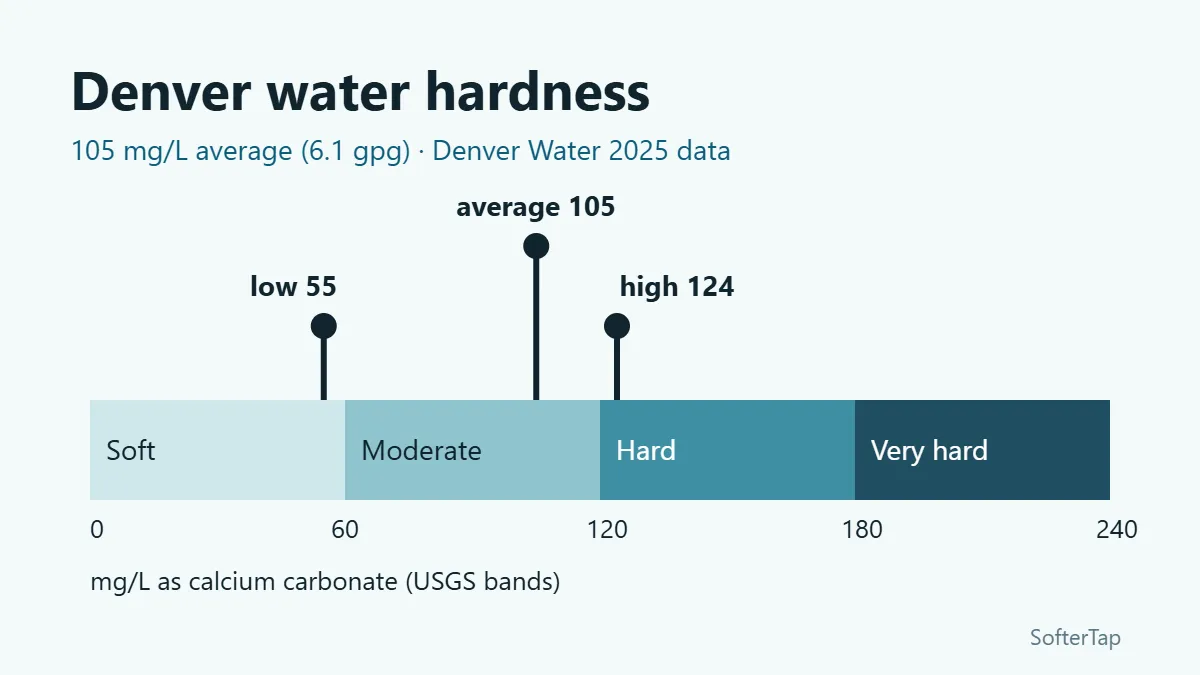
Denver water hardness averaged 105 mg/L in 2025, or about 6.1 grains per gallon (gpg), which is moderately hard. Denver Water’s own samples ranged from 55 to 124 mg/L (3.2 to 7.2 gpg) across the year, so the water is soft at its lowest and just into the hard band at its highest.
On this page
- How hard is Denver water?
- Why Denver water hardness changes by area and season
- Calcium and magnesium: what the hardness is made of
- Do you need a water softener in Denver?
- Softener size and salt for Denver water
- How much sodium softening adds to Denver water
- Denver compared with other cities
- How to check your own Denver address
- Denver water hardness FAQ
How hard is Denver water?
Denver Water’s 2026 Water Quality Report (which covers data collected in 2025) lists total hardness for the whole distribution system, sampled quarterly. The average was 105,009 ppb, which is 105 mg/L. The lowest quarterly reading was 55 mg/L and the highest was 124 mg/L.
The USGS bands are 0 to 60 mg/L soft, 61 to 120 moderately hard, 121 to 180 hard and over 180 very hard. On that scale Denver’s average sits in the middle of the moderately hard band, with a low reading in soft territory and a high one barely over the hard line. Denver Water itself describes its water as “soft to moderately hard”.
| Year of data | Lowest | Average | Highest |
|---|---|---|---|
| 2024 (2025 report) | 48 mg/L · 2.8 gpg · soft | 89 mg/L · 5.2 gpg · moderately hard | 116 mg/L · 6.8 gpg · moderately hard |
| 2025 (2026 report) | 55 mg/L · 3.2 gpg · soft | 105 mg/L · 6.1 gpg · moderately hard | 124 mg/L · 7.2 gpg · hard |
The average rose by about 18% from one year to the next (89 to 105 mg/L). That is a big enough swing to matter if you set a softener once and forget it, and a good reason to look at the newest report each summer.
Why Denver water hardness changes by area and season
Denver Water says the southern part of its system is moderately hard and the northern part is somewhat soft. It also says the water is slightly harder in winter and softer from late spring through fall.
The practical effect is that two neighbours on different sides of the system can see different numbers, and the same tap can read a few grains apart in January and July. The report’s range (55 to 124 mg/L) is the realistic window for a home on Denver Water. A single test strip result tells you where you were that day, not the year.
One more catch: not every address with a Denver mailing address is on Denver Water. If your bill comes from another district or city utility, use that utility’s report instead, and see how to read a water quality report to find the hardness line.
Calcium and magnesium: what the hardness is made of
Hardness is the combined effect of dissolved calcium and magnesium. The same report gives both, so the 105 mg/L average can be rebuilt from its parts: calcium hardness is 2.497 times the calcium concentration, and magnesium hardness is 4.118 times the magnesium concentration.
| Mineral | Concentration | Hardness as CaCO3 | Share of total |
|---|---|---|---|
| Calcium | 29.75 mg/L | 74.3 mg/L | 71% |
| Magnesium | 7.46 mg/L | 30.7 mg/L | 29% |
| Total | 105.0 mg/L (6.1 gpg) | 100% |
Alkalinity averaged 65 mg/L, about 62% of the hardness. That part is carbonate hardness, which is the kind that turns into scale when water is heated. The other 40 mg/L is non-carbonate hardness.
Do you need a water softener in Denver?
Often not urgently, and that is a more honest answer than most softener adverts give. Denver Water says scale typically takes two to five years to form, and that hardness is no longer much of an issue for laundry because modern detergents carry their own softeners.
The case for one is cumulative. At 6 to 7 gpg you will still get spots on shower glass, a crust on kettles and a slow build-up in a water heater, and the winter readings are the worst. Homes with a tankless heater, an ice maker or a lot of glass tend to notice it first. If you are weighing it up, our guide on whether you need a water softener walks through the decision, and the sizing and salt numbers below show what running one would involve.
Softener size and salt for Denver water
Use the average, 6.13 gpg, and the standard allowance of 80 gallons per person per day. A family of four then removes 4 × 80 × 6.13 = 1,963 grains of hardness a day, or about 716,000 grains a year. The salt that takes depends on the dose the softener is set to; the three doses come from the Pentair capacity table in our sizing guide. A family of four needs about 168 lb of salt a year on the low dose (4,272 grains per lb), 230 lb on the medium dose (3,113) and 368 lb on the maximum dose (1,945). Two people need 84, 115 and 184 lb, and five people 210, 288 and 460 lb.
Worked example. A four-person home with the medium dose (7.9 lb of salt, 24,593 grains of capacity) uses 1,963 grains a day, so the resin is spent after 12.5 days. That is 29 regenerations a year and about 230 lb of salt, a little under six 40 lb bags. Because the real hardness moves between roughly 3 and 7 gpg, the meter will stretch some cycles and shorten others. If the unit is on a fixed timer, you pay for the gap between the setting and the actual water.
The softener salt calculator runs the same sum with your own numbers. Denver is not in the hardness lookup yet, so enter 6.1 gpg by hand. For the setting itself, the hardness setting guide explains why people round up slightly, which here means 6 to 7 gpg.
How much sodium softening adds to Denver water
Ion exchange swaps each unit of hardness for sodium; the rate is worked out in potassium chloride vs salt. Denver Water reports sodium at each plant’s entry point, so the combined figure is easy to work out.
| Plant | Sodium reported | Added at 6.13 gpg | Softened total |
|---|---|---|---|
| Foothills | 23.7 mg/L | 48.2 mg/L | 72.0 mg/L |
| Marston | 23.8 mg/L | 48.2 mg/L | 72.1 mg/L |
| Northwater | 12.3 mg/L | 48.2 mg/L | 60.5 mg/L |
Fully softened Denver water carries roughly three to five times the sodium it started with. Anyone on a sodium-restricted diet should ask their doctor; the point here is only the arithmetic. A softener that leaves the kitchen cold tap unsoftened, or a potassium-based salt, are two options covered in our potassium vs sodium salt comparison.
Denver compared with other cities
Denver is among the softer cities SofterTap covers: only Austin averages lower, and Las Vegas and Indianapolis are two to three times harder. Denver averages 105 mg/L (6.1 gpg) against 93 mg/L in Austin, 139 mg/L in Chicago and about 240 mg/L in San Diego; Las Vegas is 280 mg/L (16 gpg) and Indianapolis 317 mg/L (19 gpg). See water hardness by city for the full comparison with each utility’s source.
How to check your own Denver address
Start with your water bill to confirm the supplier, then open that supplier’s latest water quality report and look for “hardness” in the distribution-system table. Denver Water publishes new reports each year, so use the newest one. For a home reading, a drop-count or test-strip kit shows hardness in minutes; how to test water hardness explains which kits are worth the money.
Denver water hardness FAQ
Is Denver water hard or soft?
Moderately hard on average. Denver Water’s 2025 data averaged 105 mg/L (6.1 gpg), with quarterly readings from 55 mg/L (soft) to 124 mg/L (just into hard). Denver Water calls its water soft to moderately hard.
How many grains per gallon is Denver water?
About 6.1 gpg on average in 2025, between 3.2 and 7.2 gpg across the year. The 2024 average was 5.2 gpg. One grain per gallon equals 17.12 mg/L.
Is Denver water harder in winter?
Slightly, according to Denver Water. It reports the water as a little harder in winter and softer from late spring through fall.
What hardness should I set a softener to in Denver?
Between the average and the high end, so 6 to 7 gpg. Test the softened water after a few weeks. If you find hardness leaking through, nudge the setting up by 1 gpg.
Does Denver’s hardness change from year to year?
Yes. The system average was 89 mg/L (5.2 gpg) in 2024 and 105 mg/L (6.1 gpg) in 2025, so a softener setting made from an old report can drift out of date.
Why does my Denver water leave spots on glasses?
Dishwasher spots come from dissolved minerals drying on the glass. Even moderately hard water at 105 mg/L can do it, especially in winter. A rinse aid and the right dishwasher setting help; see our dishwasher hardness setting guide.
Sources
- Denver Water: 2026 Water Quality Report (PDF): 2025 hardness, alkalinity, calcium, magnesium and sodium
- Denver Water: 2025 Water Quality Report (PDF): 2024 hardness values
- Denver Water: Water hardness (soft to moderately hard, seasonal change, scale)
- USGS Water Science School: Hardness of water (classification bands)