
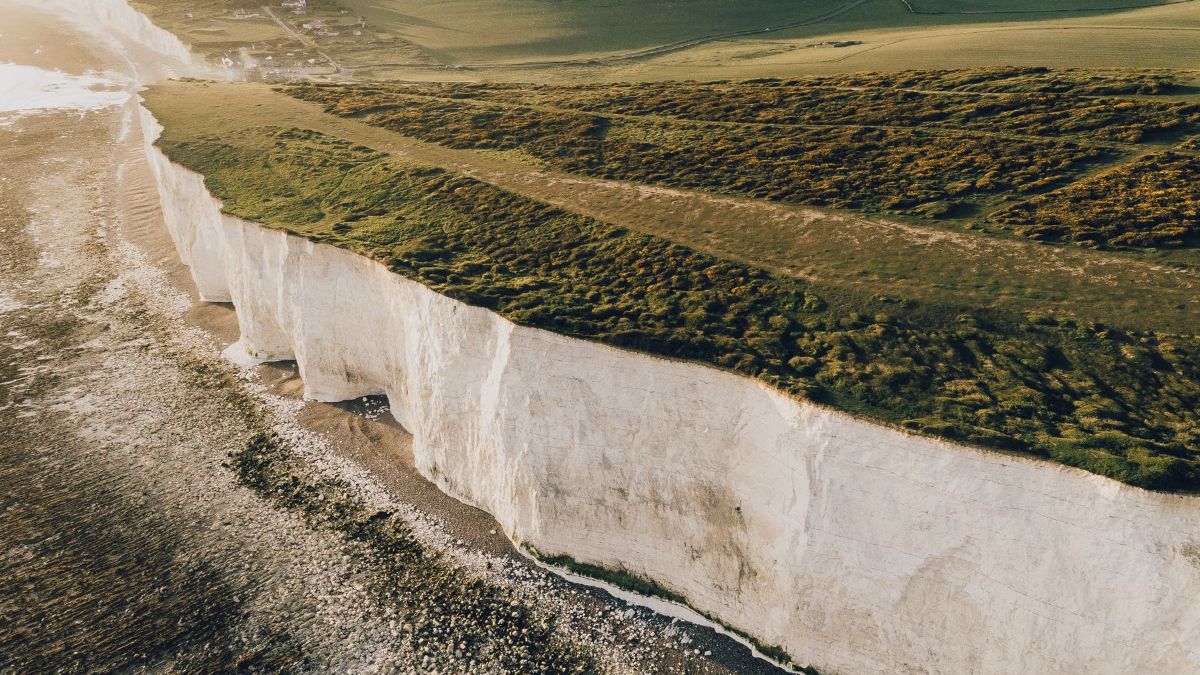
UK water hardness ranges from soft in most of Scotland, Wales and north-west England to hard and very hard across London, the South East and the East of England, where water passes through chalk and limestone. The Drinking Water Inspectorate calls water above 200 mg/l of calcium carbonate “hard” and above 300 mg/l “very hard”. There’s no legal limit for hardness, and your water company’s postcode checker gives the figure for your home.
On this page
This guide explains the bands UK water companies use, why the country splits roughly north-west to south-east, how to convert the figure for a dishwasher or softener, and the UK-specific rules for fitting a water softener.
How hard is “hard” in the UK?
There’s no single official scale. The Drinking Water Inspectorate (DWI), which regulates drinking water in England and Wales, uses five bands. United Utilities splits the bottom band in two, and other companies use their own labels.
| mg/l CaCO3 | DWI label | United Utilities label | Clark degrees | German °dH |
|---|---|---|---|---|
| 0–50 | Soft (up to 100) | Soft | 0–3.5 | 0–2.8 |
| 51–100 | Moderately soft | 3.6–7.0 | 2.9–5.6 | |
| 100–150 | Slightly hard | Slightly hard | 7.0–10.5 | 5.6–8.4 |
| 150–200 | Moderately hard | Moderately hard | 10.5–14.0 | 8.4–11.2 |
| 200–300 | Hard | Hard | 14.0–21.0 | 11.2–16.8 |
| Over 300 | Very hard | Very hard | Over 21 | Over 16.8 |
The labels differ from the US ones. The USGS calls anything over 180 mg/l “very hard”, while the DWI waits until 300. The same water can be “hard” in a UK leaflet and “very hard” on a US website. Our water hardness scale lines the systems up side by side.
The north-west to south-east split
Hardness follows geology. Thames Water puts it simply: hard water is found in areas with chalk and limestone geology, where water picks up carbonates as it passes through the rock.
That’s why the picture changes across the country:
- London and the South East. Thames Water says most water in the South-East of England is hard, and that all supplies in its area are generally classified as hard. Guildford is its softest region.
- East of England. Anglian Water describes its chalk-country region as hard to very hard.
- North West England. United Utilities publishes a full six-band scale, starting from “soft” at 0–50 mg/l, and stresses that none of its supplies is artificially softened: what you get is the natural hardness of your source.
- Scotland. Scottish Water says most of its raw water comes from lochs, rivers and burns and tends to be soft to slightly hard. Water from boreholes can be harder.
Local variation is real. The DWI warns that some areas have variation not shown on regional maps, and Scottish Water says its supplies range from 10 to 500 mg/l. Your own postcode result always beats a regional rule of thumb.
Where to find your figure
- Find your water supplier on your bill. Use the company that supplies your drinking water, which isn’t always the one that handles your waste water.
- Use its postcode checker. Thames Water, United Utilities, Anglian Water and others publish hardness by supply zone.
- Note the unit. UK reports usually give mg/l of calcium carbonate, and often Clark degrees, German degrees or mg/l of calcium alongside.
- Watch for “mg/l Ca”. Calcium alone is a smaller number than total hardness as calcium carbonate. United Utilities’ table shows the link: 61–80 mg/l of calcium sits in its “moderately hard” band of 151–200 mg/l as CaCO3.
Scottish Water customers can ask its helpline for their zone’s figure. Our guide to reading a water quality report covers the units in more depth.
Got a figure in Clark degrees or mg/l? The converter turns it into German degrees, mmol/L or grains per gallon for any appliance or softener.
Converting UK hardness units
Clark degrees are the old English unit: one grain of calcium carbonate per imperial gallon. Because the imperial gallon is about 20% bigger than the US gallon, a reading in Clark degrees is about 1.2 times the same water’s US grains per gallon. The DWI’s 300 mg/l “very hard” line, for example, is 21.0 °Clark, 16.8 °dH, 30 °f, 3.0 mmol/L or 17.5 US gpg. Other conversions are in the gpg to ppm conversion tables and the hardness converter.
Setting a dishwasher in a hard water area
Most dishwashers sold in the UK ask for German degrees or mmol/L and group them into levels. In a London-type area at 250 to 300 mg/l, that’s about 14 to 17 °dH, or 2.5 to 3.0 mmol/L, which most manuals put in their upper levels.
Keep the salt compartment topped up with dishwasher salt; the built-in softener needs it to regenerate. Our dishwasher hardness setting guide maps mmol/L to the levels used by common models.
Water softeners in the UK: the rules that differ
UK guidance on softeners is stricter than most US advice, and it comes from the regulator itself. The DWI advises:
- keeping an unsoftened supply to the kitchen tap for drinking and cooking;
- not using artificially softened water to make up baby feeds;
- using a qualified plumber, and checking with your water company that the device meets the Water Supply (Water Fittings) Regulations 1999;
- backwashing and topping up salt as the maker says, and considering a service agreement.
The reason is sodium. The DWI notes the drinking water regulations include a sodium standard, and softening may risk breaching it. United Utilities says softeners should be fitted after the drinking water tap for the same reason, and Thames Water doesn’t recommend softened water for drinking or cooking.
Scale-reducing devices that don’t use salt are a different technology with different claims. Our comparison of salt-free and salt-based softeners explains what each one actually does.
Sizing a softener in UK units
Softener capacities are usually rated in grains, a US unit, even on units sold in Britain. To size one, convert your figure to US grains per gallon and your daily use to US gallons.
Worked example. A household in a 300 mg/l area uses 450 litres a day. 300 ÷ 17.118 = 17.5 gpg. 450 litres ÷ 3.785 = 119 US gallons. 119 × 17.5 = about 2,080 grains a day, or about 14,600 a week. A 24,000-grain softener at a medium salt setting covers that with room to spare.
The softener size calculator accepts mg/l and does the conversion for you.
Thinking about a softener? Enter your postcode figure and household size to see the size and salt use, with each step shown.
Frequently asked questions
Where is the hardest water in the UK?
In the chalk and limestone areas of London, the South East and the East of England. Thames Water and Anglian Water both describe their supplies as hard, and in places very hard.
Is hard water safe to drink in the UK?
Yes. The DWI sets no standard for hardness, and water companies such as Thames Water say it isn’t considered harmful.
What is a Clark degree?
The traditional English hardness unit, equal to 14.254 mg/l of calcium carbonate. It’s about 1.2 times the US grains-per-gallon figure for the same water.
Do I need permission to fit a water softener?
No permission as such, but the installation must meet the Water Fittings Regulations, and the DWI suggests checking with your water company and using a qualified plumber.
Is Scottish water soft?
Mostly. Scottish Water says most of its raw water comes from surface sources that tend to be soft to slightly hard, though some borehole supplies are harder.
Sources
- Drinking Water Inspectorate: Water hardness / hard water
- Drinking Water Inspectorate: Domestic water filters and softeners
- Thames Water: Hard water
- Thames Water: Water hardness (archived copy)
- United Utilities: Water hardness factsheet 2024 (PDF)
- Scottish Water: Water hardness factsheet (PDF)
- Anglian Water: Water quality fact sheet, hard water (PDF)