
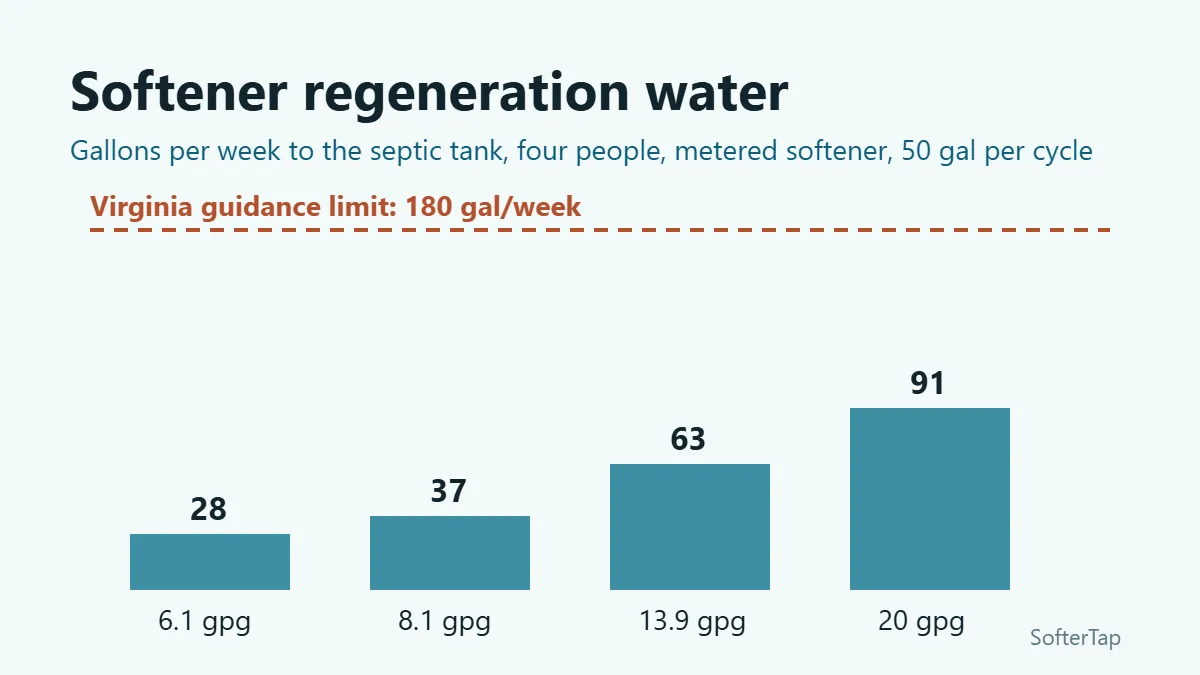
A water softener and septic system can work together if the softener regenerates efficiently and sends a modest amount of water to the tank. The firmest numbers on record are a Virginia guidance memo: no more than 60 gallons of brine per regeneration and 180 gallons per week. A four-person home with a metered softener sends roughly 30 to 90 gallons a week to the tank at hardness between 6 and 20 gpg, well inside that limit.
On this page
- Can a water softener and septic system work together?
- What a regeneration sends to the septic tank
- How many gallons a week does a softener send to septic?
- Timer-set softeners and the weekly limit
- Efficiency matters more than the gallons per cycle
- How to protect your septic system with a softener
- Water softener and septic system FAQ
Can a water softener and septic system work together?
Generally yes, with two conditions: the softener should be efficient, and its regeneration water shouldn’t overload the tank and drainfield. Two sources set the ground rules, and both have limits worth knowing.
The first is a 1994 memo from Virginia’s onsite sewage division, GMP #57. It says a regeneration cycle should discharge 60 gallons of brine or less to the septic system, and no more than 180 gallons a week in total. It notes that a typical regeneration sends about 50 gallons, too little to cause hydraulic overload, and that softeners inside those limits need no change to the design of the septic system. Softeners above them call for a bigger disposal system. This is one state’s guidance from 1994, not a national rule, but it is the clearest published benchmark.
The second is the Water Quality Association’s summary of an 18-month Virginia Tech study. It found that efficiently operated softeners improved septic tank performance, while very inefficient units might harm the solids discharged to the drainfield. The WQA is the water treatment industry’s trade group, and the study was funded by its research foundation, so read the findings with that in mind.
What a regeneration sends to the septic tank
A regeneration sends water to the drain in several stages: backwash, brine draw and slow rinse, fast rinse and brine refill. Pentair’s owner’s manual says a regeneration can last up to two hours, lists drain flows of 2.5 to 3.5 gallons a minute depending on the model, and sets the default start at 2:00 AM when water use is low. Our guide to how much water a softener uses covers the stages.
The WQA says the salt in the brine is diluted about sixfold by the rinse during regeneration and by a further 160 to 400 times when it mixes with the rest of the household’s wastewater. It also says the main worry is excess sodium, which can hinder solids settling in the tank and reduce soil drainage, while the calcium and magnesium in softener waste can help settling and soil structure when present in the right amounts.
How many gallons a week does a softener send to septic?
Take a four-person home using 80 gallons per person per day and a softener with 24,593 grains of capacity (the 7.9 lb salt dose in our sizing guide). Each regeneration is assumed to use 50 gallons, which is the typical figure in the Virginia memo, or 60 gallons, which is its limit. A demand-initiated (metered) softener regenerates only when the capacity is used up.
| Water hardness | Grains used per day | Regenerations per week | Gallons per week (50 per cycle) | Gallons per week (60 per cycle) |
|---|---|---|---|---|
| 6.1 gpg (Denver) | 1,962 | 0.56 | 28 | 34 |
| 8.1 gpg (Chicago, Grand Haven) | 2,592 | 0.74 | 37 | 44 |
| 13.9 gpg (San Diego) | 4,448 | 1.27 | 63 | 76 |
| 20 gpg (very hard well water) | 6,400 | 1.82 | 91 | 109 |
Worked example. At 13.9 gpg, four people use 4 × 80 × 13.9 = 4,448 grains a day. The softener is spent in 5.5 days, so it regenerates 1.27 times a week. At 50 gallons a time that is about 63 gallons a week, 35% of Virginia’s 180-gallon limit. The household itself uses 4 × 80 × 7 = 2,240 gallons a week, so the regeneration is under 3% of the water going through the tank.
For scale, EPA says a single running or leaky toilet can add as much as 200 gallons a day. That is up to 1,400 gallons a week, more than twenty times the softener’s contribution in the example.
Timer-set softeners and the weekly limit
A softener set on a fixed timer regenerates on schedule whether or not the resin is used up. That is where the limit starts to bite. Many valves also force a regeneration after a maximum number of days; see how often a softener should regenerate.
| Regeneration schedule | Per week | Gallons per week (50 per cycle) | Gallons per week (60 per cycle) |
|---|---|---|---|
| Every 7 days | 1 | 50 | 60 |
| Every 3 days | 2.33 | 117 | 140 |
| Every 2 days | 3.5 | 175 | 210 (over the limit) |
| Every day | 7 | 350 (over the limit) | 420 (over the limit) |
A softener that is regenerating every other day when the household only needs it twice a week is where a weekly cap starts to matter. If yours is on a timer, check the setting against your actual hardness and household size.
Efficiency matters more than the gallons per cycle
A bigger softener uses more water per regeneration but regenerates less often. The fairer measure is gallons per 1,000 grains of hardness removed. NSF/ANSI 44 rates an efficient softener at 5.0 gallons or less per 1,000 grains. Here is what that means for a 24,593-grain regeneration against the Virginia cycle limit.
| Gallons per 1,000 grains | Gallons per regeneration | Gallons per week at 13.9 gpg | Hardness at which the weekly total reaches 180 gal |
|---|---|---|---|
| 2.0 (typical, 50 gal) | 50 | 63 | 39.5 gpg |
| 2.4 (Virginia limit, 60 gal) | 60 | 76 | 32.9 gpg |
| 5.0 (NSF/ANSI 44 ceiling) | 123 | 156 | 16.1 gpg |
The practical point: a softener comfortably under the NSF/ANSI 44 ceiling, and set to match your actual hardness, is what both the Virginia memo and the WQA are really asking for. The hardness setting guide explains how to set it.
How to protect your septic system with a softener
- Choose and set for efficiency. The WQA advises a high-efficiency or demand-initiated regeneration softener with the salt level set to match its efficiency rating.
- Fix the leaks first. EPA says a typical home can use up to 70 gallons per person per day indoors, and one leaky toilet can add 200 gallons a day.
- Spread the laundry. EPA recommends laundry across the week instead of all in one day, which can flood the drainfield.
- Keep the tank pumped. EPA says a household tank is typically pumped every 3 to 5 years.
- Go easy on harsh chemicals. The WQA lists excessive bleach, detergents, strong disinfectants, toilet disinfectant tablets and caustic drain cleaners as things to avoid.
- Check local rules. Some places restrict how softener discharge is handled; our guide to water softener bans explains where.
If you would rather not send brine anywhere, a salt-free conditioner has no regeneration cycle at all; the trade-offs are in salt-free vs salt-based softeners.
Water softener and septic system FAQ
Is a water softener bad for a septic tank?
Not when it is efficient and set correctly. The WQA reports a Virginia Tech study in which efficiently operated softeners improved tank performance, while very inefficient units could harm the solids leaving the tank. That is industry-funded research, so also follow your local health department’s advice.
How much water does a regeneration put into a septic system?
The Virginia guidance says typical regenerations send about 50 gallons and sets 60 gallons per cycle as the limit. Your manual gives the figure for your model.
Should the softener drain go to the septic tank or somewhere else?
Follow local rules. The WQA says diverting the regeneration waste can reduce the calcium and magnesium returning to the system, which may increase solids in the effluent, while waste high in excess sodium can also be a problem.
How often should a septic tank be pumped with a softener?
EPA says a household tank is typically pumped every 3 to 5 years and inspected at least every 3 years. A softener does not change that guidance, but your installer or local health department may advise differently.
Do salt-free water conditioners avoid the septic question?
They do not regenerate with brine, so there is no regeneration discharge. They also do not remove hardness the way a softener does; see our comparison.
Can I use a softener if I am on well water and septic?
Often yes, but well water can be much harder and carry iron, which changes the sums. Test first with our well water hardness guide, then size the softener to your actual numbers.
Sources
- Virginia onsite sewage division: GMP #57, Water Softener Regeneration Discharge into Drainfields (1994, PDF)
- Water Quality Association: Softeners and Septic Performance (septic toolkit, PDF)
- ASDWA: Changes in septic tank effluent due to water softener use (Virginia Tech study abstract shared by the WQA)
- US EPA: How to care for your septic system
- Pentair: Whole-house softener owner’s manual (PDF): regeneration time, drain flow, default start