
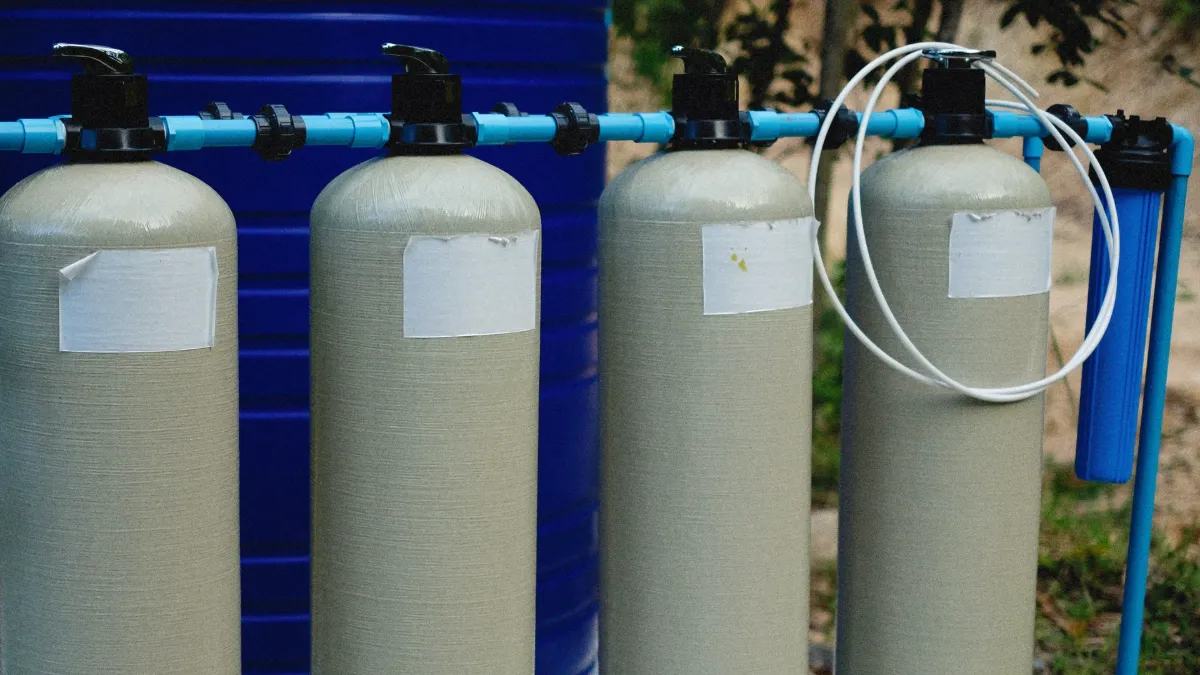
A single tank water softener goes offline for up to two hours each time it regenerates, and sends hard water to your taps while it does. A twin tank softener keeps one tank in service while the other regenerates, so the water is always soft. The salt saving people often quote for twin tanks is small: our calculation puts it at roughly 2 to 15% for typical homes. Most households are fine with a single tank; twin tanks earn their price in homes that use water at night or have very hard water.
On this page
- What is the difference between a single and twin tank softener?
- What happens to your water while a single tank regenerates?
- How much salt does a twin tank softener actually save?
- When does a single tank run out of soft water?
- Non-electric twin tank softeners (Kinetico and UK systems)
- Single or twin tank: which should you choose?
- Mistakes when comparing single and twin tank softeners
- Twin tank water softener FAQ
What is the difference between a single and twin tank softener?
Both types soften water the same way. Hard water flows through a tank of resin beads, the beads trade calcium and magnesium for sodium, and a brine rinse from the salt tank recharges them. The difference is how many resin tanks share one control valve.
A single tank softener has one resin tank. When the resin needs recharging, the whole softener stops softening and regenerates, usually at a quiet time such as 2:00 a.m.
A twin tank softener has two resin tanks on one valve. Pentair describes its Fleck 9100 twin valve as giving continuous soft water with only one tank in use at a time, the other either regenerating or on standby, and as regenerating with softened water. Kinetico’s twin tank systems work the same way, with one tank always in service.
| Feature | Single tank | Twin tank |
|---|---|---|
| Soft water during regeneration | No: hard water goes to the house | Yes: the second tank takes over |
| When it regenerates | Usually at a set time, often 2:00 a.m. | When a tank is used up, at any hour |
| Reserve capacity | Needed, so it doesn’t run out before the set time | Not needed |
| Space | One resin tank plus a brine tank | Two resin tanks plus a brine tank |
| Power | Usually electric | Electric or non-electric (water-powered) |
What happens to your water while a single tank regenerates?
You get hard water. Pentair’s owner’s manual for its whole house softeners says it plainly: the system diverts hard water to the home during regeneration, and if you run water then, some of that hard water will reach your plumbing and possibly the water heater. The same manual recommends a 2:00 a.m. start and warns the cycle can last up to two hours.
For most families that’s a non-event: nobody is showering at 3 a.m. It becomes a real problem when:
- someone works nights and showers or runs laundry in the early hours;
- the dishwasher or washing machine runs on a delay timer set overnight;
- a tankless water heater or boiler draws water at night;
- a power cut pushes regeneration back, so the softener runs low the next day.
Each of those fills the water heater with a dose of hard water. That’s exactly the scale a softener is meant to prevent. If your household fits that pattern, either move the regeneration time (see how often a water softener should regenerate) or consider a twin tank.
How much salt does a twin tank softener actually save?
Less than the marketing suggests. A single tank softener has to keep a reserve: it regenerates at 2 a.m. if the capacity left looks too small to last another day. Pentair’s manual starts that reserve at 25% of capacity and then adjusts it to your daily use. The part of the reserve still unused when it regenerates is salt you paid for and never used.
A twin tank doesn’t need a reserve. It runs one tank until it’s empty, then switches. To put a number on the difference, we modelled a single tank that keeps about one day’s water as reserve (we used people × 70 gallons × hardness) and, on average, regenerates with half of it unused. The twin tank uses its full capacity.
| Household | 10 gpg | 15 gpg | 20 gpg | 25 gpg |
|---|---|---|---|---|
| 2 people | 2.2% | 3.4% | 4.6% | 5.8% |
| 4 people | 4.6% | 7.0% | 9.6% | 12.3% |
| 6 people | 7.0% | 10.9% | 15.1% | 19.6% |
In salt and money, that difference is modest. At 3,350 grains per pound (the NSF/ANSI 44 efficiency rating) and $8.76 for a 40-pound bag:
| Household and hardness | Twin tank | Single tank | Difference | Cost of difference |
|---|---|---|---|---|
| 2 people, 10 gpg | 174 lb | 178 lb | 4 lb | $1 |
| 4 people, 10 gpg | 349 lb | 365 lb | 16 lb | $3 |
| 4 people, 15 gpg | 523 lb | 560 lb | 37 lb | $8 |
| 4 people, 20 gpg | 697 lb | 764 lb | 67 lb | $15 |
| 6 people, 20 gpg | 1,046 lb | 1,204 lb | 158 lb | $35 |
Quick example: four people on 15 gpg water
The family uses 4,800 grains a day. A 32,000 grain twin tank regenerates about every 6.7 days. A single tank with a 4,200 grain reserve regenerates, on average, with 2,100 grains still in the resin, so it manages about 29,900 grains per cycle and regenerates every 6.2 days. Over a year that’s about 37 pounds more salt, or $8. A twin tank costing several hundred dollars more would take decades to pay back on salt alone.
The water used to regenerate scales the same way, since each regeneration uses a similar volume. Our guide to how much water a softener uses gives typical gallons per cycle.
When does a single tank run out of soft water?
Almost never in an ordinary home. A single tank only fails during the day if one day’s use is bigger than the capacity left after the reserve. With the same reserve rule, that happens at these hardness levels:
| Household | 24,000 grains | 32,000 grains | 48,000 grains |
|---|---|---|---|
| 2 people | 80 gpg | 107 gpg | 160 gpg |
| 4 people | 40 gpg | 53 gpg | 80 gpg |
| 6 people | 27 gpg | 36 gpg | 53 gpg |
Most US city water is well under 25 gpg. The cases where a single tank struggles are large families on very hard well water, guest-heavy weekends in a small unit, or a softener that was simply undersized. A bigger single tank fixes the last two; see 32,000 vs 48,000 grain softeners for the sizing trade-off.
Non-electric twin tank softeners (Kinetico and UK systems)
Many twin tank softeners have no plug at all. Kinetico’s run on the pressure of the water flowing through them, meter the water you use, and regenerate when a tank is used up, at any time of day.
The design is common in the UK too. Culligan Harvey, a long-established UK brand, describes its domestic softeners as twin-cylinder, non-electric and powered by water pressure alone, and many of its models use block salt rather than the pellets common in US homes. If you’re comparing UK quotes, a “twin cylinder” softener is the same idea as a US “twin tank”.
No electricity means one less thing to fail in a power cut and nothing to reset afterwards. The trade-off is that you can’t adjust these units the way you can a digital valve; settings are usually made by the installer.
Single or twin tank: which should you choose?
Start from how your household uses water, not from salt savings. The salt difference is small either way.
Choose a single tank if…
- almost no one uses hot water between about 2 and 4 a.m.;
- your hardness is under about 25 gpg and the softener is sized for your household;
- you want the lowest purchase price, the most models to choose from and easy-to-find parts;
- space is tight, since you only need room for one resin tank.
Choose a twin tank if…
- someone works nights, or appliances run on overnight timers;
- you have a tankless heater or boiler you want to keep hard water away from at all hours;
- your water is very hard and the household is large, so a single tank would regenerate almost every night;
- you’d like a non-electric softener that keeps working through power cuts.
Not sure what capacity you need either way? The water softener size calculator works out grains per day from your hardness and household, and our water softener guide covers the other choices, from salt type to certification.
Mistakes when comparing single and twin tank softeners
Comparing a twin tank with an old timer softener. Many “twin tanks save 20 to 40%” claims compare a metered twin tank with a timer-based single tank that regenerates on a fixed schedule whether you used water or not. Most of that saving comes from the meter, not the second tank. A metered single tank closes most of the gap.
Reading the capacity wrong. On a twin system, check whether the quoted capacity is per tank or for both together. You only ever use one tank at a time, so the capacity per tank is what decides how often it regenerates.
Forgetting the bypass. Both types should be fitted with a bypass valve, so you can isolate the softener for service. Our guide to the water softener bypass valve shows what it does.
Assuming twin means bigger. Two tanks don’t double the softening you get per cycle. If the problem is running out of soft water, a larger single tank is often the cheaper fix.
Twin tank water softener FAQ
Is a twin tank water softener worth it?
For most homes, only if hard water at night matters to you. The salt saving in our calculation is a few dollars a year for a typical family, so the case rests on continuous soft water, not running costs.
Do twin tank softeners use less water?
A little, in proportion to the fewer regenerations: a few percent in typical homes, up to about 20% for a large family on very hard water. Each regeneration uses a similar volume of water either way.
Can I add a second tank to my single tank softener?
Not to an ordinary single tank valve. Twin systems use a valve built to switch between two tanks, such as Pentair’s Fleck 9100, so the change means a new control valve as well as a second tank.
Can I avoid hard water during regeneration without a twin tank?
Yes, mostly. Set regeneration for a time when nobody uses water, avoid overnight appliance timers on regeneration nights, and size the softener so it doesn’t regenerate every night.
Sources
- Pentair: Whole House Water Softening System installation and owner’s manual (PDF): hard water during regeneration, 2:00 a.m. start, up to two hours, 25% initial reserve
- Pentair: Fleck 9100 twin valve technical sheet (PDF): continuous soft water, regeneration with softened water
- Kinetico: Water softeners, everything you need to know (non-electric, one tank always in service)
- Culligan Harvey: Product facts (twin-cylinder, non-electric, block salt)
- PNNL Building America Solution Center: Water Softeners (NSF/ANSI 44 efficiency rating)