
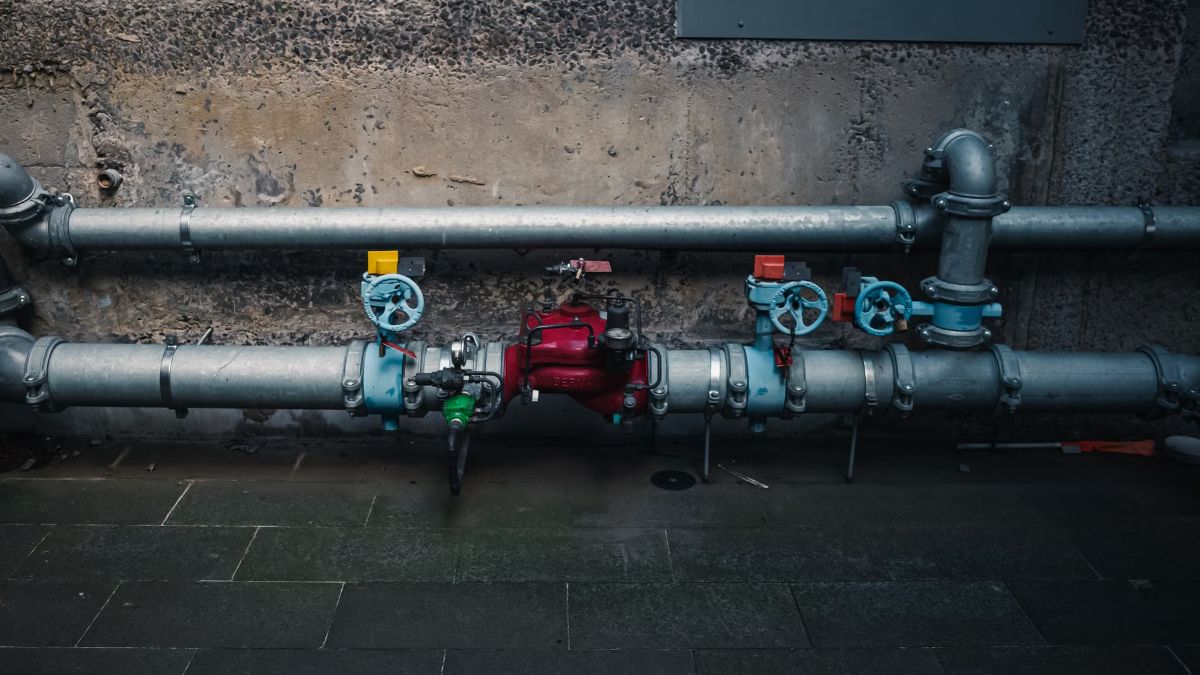
A water softener bypass valve sends water around the softener instead of through it, so your house keeps running water while the softener is off. Use it for leaks, repairs and servicing, and, as Pentair’s manual recommends, whenever you water outside for long periods. On a common single-valve design, such as Whirlpool’s, you push the stem in for “bypass” and pull it out for “service” (soft water).
On this page
Bypass valves are simple, but getting the order wrong when you switch back can push air or a pressure surge through the softener. Here’s how they work, when to use one and how to return to service safely.
What the bypass valve does
A softener sits on the main water line. Normally all your water flows in through the inlet, through the resin, and out to the house. The bypass gives that water a shortcut.
| Position | Water path | What comes out of your taps |
|---|---|---|
| Service | Through the softener | Soft water |
| Bypass | Around the softener | Hard water, straight from the supply |
Whirlpool’s manual describes the purpose plainly: bypass valves let you turn off water to the softener for maintenance while the house pipes still have water.
The two main designs
Single bypass valve
Most modern softeners come with one bypass valve fitted to the control head. On Whirlpool’s demand-controlled models it’s a push-pull stem: push in for bypass, pull out for service. Other brands use a lever or a rotating knob, usually with arrows or labels moulded into the body. If yours isn’t labelled, check the manual before turning anything.
Three-valve bypass
Some installations use three ordinary shut-off valves instead: one on the inlet pipe, one on the outlet pipe, and one on a loop that connects the two. Whirlpool sells its softeners without one but shows how to assemble a three-valve bypass from parts.
- Bypass: inlet and outlet valves closed, bypass valve open.
- Service: bypass valve closed, inlet and outlet valves open.
When to put the softener in bypass
Pentair’s manual lists three main reasons: emergency leaks in the equipment, service calls, and outdoor water use. In practice that covers:
- a leak at the softener, its fittings or the brine tank;
- repairs or servicing, including replacing the control valve or cleaning the brine tank;
- long spells of watering the garden, washing the car, or filling a pool;
- plumbing work elsewhere in the house, if the softener could be disturbed;
- first start-up after installation, when Pentair says to leave the system in bypass, turn the water on and check for leaks.
Why bypass for outdoor water
Every gallon through the softener uses up capacity, and the lawn doesn’t need soft water. The Minnesota Department of Health notes that outdoor taps and other cold taps usually don’t need to be softened at all.
| Outdoor use | At 10 gpg | At 15 gpg | At 20 gpg |
|---|---|---|---|
| 100 gallons | 1,000 grains (4%) | 1,500 grains (6%) | 2,000 grains (8%) |
| 300 gallons | 3,000 grains (12%) | 4,500 grains (18%) | 6,000 grains (23%) |
| 1,000 gallons | 10,000 grains (39%) | 15,000 grains (59%) | 20,000 grains (78%) |
A few hours of watering can bring forward a regeneration by days, costing salt and water for nothing. If your home has an outdoor tap that’s already plumbed before the softener, use that instead.
How to put a softener in bypass
- Find the valve. It’s usually on the back of the control head where the pipes connect, or on the pipes just before and after the softener.
- Single valve: move it to the bypass position. On push-pull designs like Whirlpool’s, push the stem in.
- Three valves: open the bypass valve first, then close the inlet and outlet valves. Opening the bypass first keeps water flowing to the house.
- Check a cold tap. Water should still run normally; it will now be hard.
If you’re bypassing because of a leak, also unplug the softener if the manual says to, so it doesn’t start a regeneration.
How to return to service
This is where care matters. Whirlpool’s instructions for a three-valve bypass: fully close the bypass valve, open the outlet valve, then open the inlet valve slowly, pausing to let the softener fill with water.
- Close the bypass (or, on a single valve, move it slowly towards service).
- Open the outlet valve, if you have one.
- Open the inlet valve slowly, in stages, so air can escape and the resin isn’t hit by a surge.
- Run a cold tap downstream for a few minutes to clear air.
- Check for leaks around the valve and fittings.
- Test the water after the next regeneration to confirm it’s soft; our guide on how to test water hardness shows how.
Back in service and want to check the settings? The size calculator shows how many grains a day your household uses, which tells you how often the softener should regenerate.
Common mistakes
- Forgetting to switch back. A bypass left open is one of the classic reasons a softener seems to stop working while the salt level never drops. See why a softener isn’t using salt.
- Bypassing during sanitising. Whirlpool’s sanitising instructions keep the valves in service so the bleach solution passes through the resin.
- Forcing a valve that won’t move. Ask the manufacturer or a plumber rather than levering it with tools; many bypass bodies are plastic.
- Stopping between positions. Move the valve fully to one position or the other, matching the labels or the manual.
Do you need the bypass during a regeneration?
No. A normal regeneration runs on its own, and manufacturers schedule it for when little water is used. Pentair’s default start is 2:00 AM, “a time when water use is minimal”, and its manual says a regeneration can last up to two hours. Leave the valve in service.
Not sure the setting matches your water? Convert your utility’s figure into grains per gallon for the softener valve.
Frequently asked questions
Is it bad to leave a water softener in bypass?
It does no harm for a short time, but your house gets hard water. For a long absence, follow the manual; our maintenance guide covers sanitising after a softener has stood idle.
How do I know if my softener is in bypass?
Check the valve against the labels or manual. If the salt level hasn’t dropped in weeks and the water feels hard, an open bypass is one of the first things to rule out.
Should I bypass the softener when watering the lawn?
Yes, for long sessions. Pentair recommends using the bypass whenever you water outside for extended periods.
Can I drink water while the softener is in bypass?
Yes. In bypass you get the same water your utility supplies, just without softening.